Dry Breton cider, Cornouaille AOP
The historic match. Its sharp acidity balances the richness of the broth.
Available at our grocery
Winter signature · October to May
Authentic Breton cooking in the 12th arrondissement, between Bastille and Nation. The traditional recipe from the Léon, a broth reduced for more than three hours, lipig sauce on the side.
2026-27 season · Kig ha farz has been back on the menu since 9 October, until 31 May
Kig ha farz (say “keeg-ah-fars”) is Brittany’s pot-au-feu: pork and beef simmered for hours with cabbage and root vegetables, served with farz, a buckwheat pudding cooked in a cloth bag in the same broth, and lipig, a salted butter and onion sauce. In Paris, Ty Louis, a Breton restaurant at 240 rue du Faubourg Saint-Antoine in the 12th arrondissement, between Bastille and Nation, serves it as its winter signature from October to May, Tuesday to Saturday, at 29,80 €.
If you are looking for kig ha farz in Paris (not a crêperie offering its own take on it, but a real Breton pot-au-feu with its traditional buckwheat pudding), you are in the right place. The dish is rare around Paris, and versions that stay faithful to the Léon tradition can be counted on one hand.
This page explains what kig ha farz really is, where to eat it in Paris, and how we make ours, served from October to May, without betraying the Breton original. If Breton food is new to you, our guide to Breton dishes beyond the crêpe is a good two-minute read first.
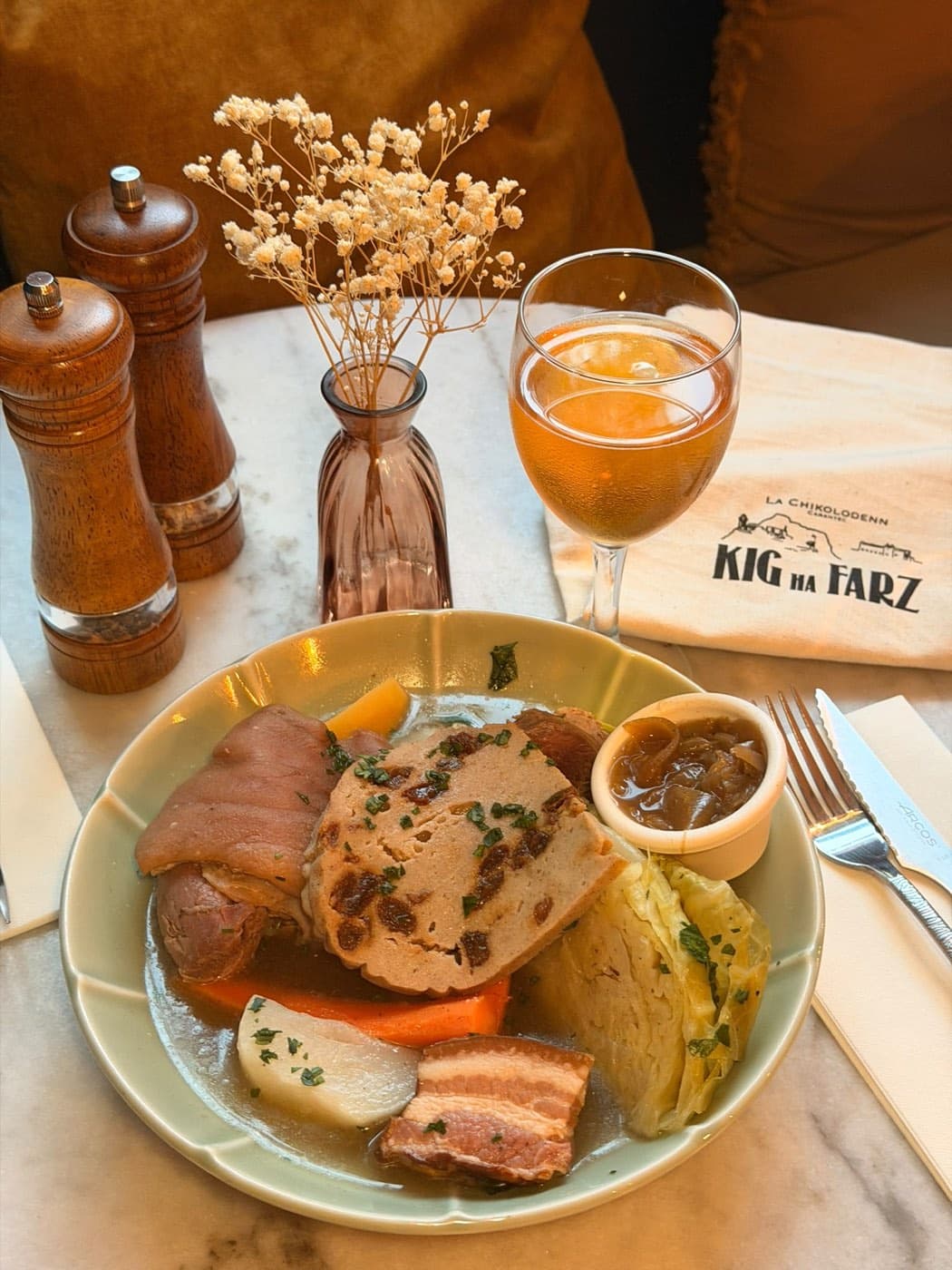
On the plate
It has been back on the menu since 9 October 2026. This is what you will find on your plate, photographed in the dining room.
On the menu · 29,80 €
Brittany’s pot-au-feu, from the Léon, simmered for 4 hours: cheek, shank and smoked pork belly, turnips, swede, carrots, Lorient green cabbage, a buckwheat pudding with raisins, lipig sauce on the side. See the full menu.
The linen pouch on the table is made by La Chikolodenn, in Carantec. You can buy one at our Breton grocery corner.
Definition
Kig ha farz is a traditional Breton pot-au-feu from the Léon, in the north of Finistère, at the western tip of Brittany. The name literally means “meat and stuffing” in Breton. Pork and beef simmer for hours with vegetables, and alongside them cooks a buckwheat pudding in a cloth bag: the farz.
The name: kig (meat) + ha (and) + farz (stuffing). Say “keeg-ah-fars”, sounding the final z clearly.
The dish comes from the heart of the Léon (around Saint-Pol-de-Léon and Lesneven, in northern Finistère), where it was traditionally cooked on Sundays to bring the family together. Unlike a classic French pot-au-feu, the side is a grain rather than potatoes: the buckwheat pudding takes their place.
Breton tradition has two versions:
A little history: buckwheat, the “black wheat” that is not actually a cereal, reached Brittany in the 15th century and took hold in the Léon, where it replaced wheat. The pudding cooks in a cloth bag rather than in an oven for a reason: back then, using the lord’s communal bread oven had to be paid for. Long seen as a poor man’s dish, kig ha farz simmered on its own while the whole family worked in the fields. Crumbled at the end of cooking, the pudding is called farz bruzunoc.
The dish’s other name
Same dish, two names. “Breton pot-au-feu” is the usual French translation, “kig ha farz” the real name. Pot-au-feu itself is France’s classic boiled beef and vegetables, but the comparison only goes so far, and here are the five places where it stops.
| Classic pot-au-feu | Kig ha farz | |
|---|---|---|
| The starch | Potatoes, cooked separately and served on the side | A buckwheat batter cooked in a cloth bag dropped into the broth, then crumbled or sliced |
| The meats | Beef: chuck, shin, short ribs, marrow bones | As much pork as beef: shank, lightly salted shoulder, bacon |
| The sauce | Mustard, gherkins and coarse salt, on the table | Lipig: onions or shallots melted in salted butter, loosened with broth |
| The vegetable that matters | Leek, carrot, turnip, celery | Savoy cabbage, with carrots, turnips and leeks |
| Where it comes from | A national dish, found all over France | The Léon, northern Finistère, around Morlaix and Brest |
If you heard it rather than read it
People hear the name before they see it written, so it gets spelled every possible way. We regularly come across kikafarce, kig a farz, kig ar farz, ki ha farz, kig-ha-farz, quique a farce. It is the same dish, and you are in the right place. The only correct Breton spelling is “kig ha farz”, in three words.
An honest comparison
Kig ha farz is not an easy dish to find in Paris. These are the few places that serve it, ranked honestly by how close they stay to the tradition.
Our winter signature. The traditional recipe from the Léon, a broth reduced for more than three hours, lipig served on the side. On the menu from October to May, Tuesday to Saturday. As far as we know, the only Breton restaurant in Paris that makes it a signature dish rather than an occasional seasonal special.
240 rue du Faubourg Saint-Antoine, 75012
A long-standing Breton bistro near Gare du Nord, run by Japanese chef Masahiro Kawai, who reworks the Breton classics with great care. Kig ha farz on the seasonal menu, in a more bistronomic version with his own touches.
10 rue de Belzunce, 75010
A crêperie that also serves kig ha farz, recommended by the Petit Futé guide. Traditional cooking and an unapologetically Breton setting. The menu covers the whole Breton repertoire, crêpes included, so the approach is different from ours.
4 rue Charlot, 75003
A friendly Breton restaurant in the 11th. A generous kig ha farz, in the spirit of a neighbourhood bistro.
4 rue du Général-Renault, 75011
How we cook it
“The exact same method you would find in a kitchen in Plouescat or Lesneven.”
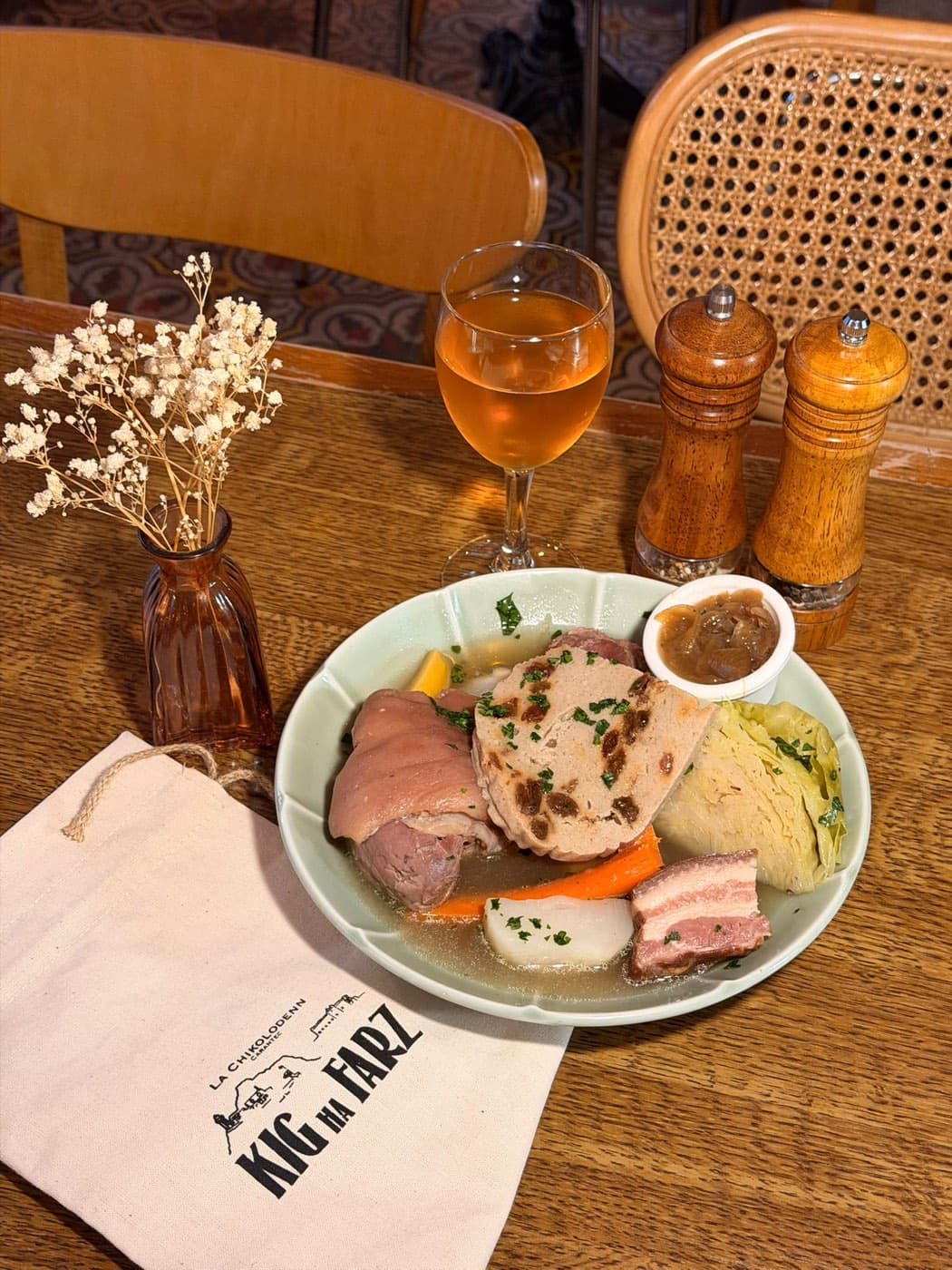
It starts with sourcing. The meats (pork and beef) come from partner producers in Brittany. The vegetables are BIO BREIZH, Brittany’s organic label, when the season allows. The buckwheat for the farz comes from a Breton mill we chose.
The dish is started in the morning. The meats go into a large stock pot with the aromatics for two hours of simmering. Meanwhile we make the farz: buckwheat flour, eggs, lait ribot (Breton buttermilk), salt and, as tradition has it, a touch of sugar. The batter goes into a cloth bag that we tie tight with string.
The bag goes into the broth and cooks gently for another hour and a half. The vegetables go in towards the end, so they stay firm and full of flavour.
When it is time to serve, we lift the bag out and open it. Tradition says you “break the farz”, crumbling it by hand while it is still hot. Ours arrives as a thick slice, raisins and all. The meats and vegetables are laid in a deep plate over a little broth, and the lipig, the slow-cooked onion sauce, comes separately, in its ramekin.
Everything is served warm, never scalding. The way it is at home in Brittany.
The traditional recipe
For anyone who wants to try it. Allow 3 hours 30 minutes to 4 hours in total, and know that it is even better reheated the next day.
Beef short ribs, pork shank, lightly salted pork shoulder, marrow bones. Cover with cold water, add an onion studded with cloves and a bouquet garni. Simmer for 2 hours, skimming as you go.
Mix 500 g buckwheat flour, 4 eggs, 500 ml lait ribot (Breton buttermilk), 1 teaspoon salt and 2 tablespoons sugar. The batter should be thick but still pourable.
Pour it into a cloth bag (or a large clean tea towel knotted at the corners) and tie it with string, without packing it tight, so the farz has room to swell.
Keep it at a gentle simmer.
One hour after the bag goes in: savoy cabbage in wedges, carrots, turnips, leeks. Cook for another 30 to 45 minutes.
Melt 150 g salted Breton butter and cook 2 large sliced onions (or shallots) in it over a very low heat, with 200 g smoked bacon lardons. Add 2 ladles of broth and reduce. The salted butter is not optional: it is what makes lipig.
Crumble the hot farz by hand for a coarse, crumbly texture.
Sliced meats, vegetables, crumbled farz. Lipig on the side. Dry Breton cider to drink.
What to drink
The dish is rich and its flavours linger. What you drink with it should clean the palate without drowning out the broth.
The historic match. Its sharp acidity balances the richness of the broth.
Available at our grocery
A less acidic option if you like your broth rich and concentrated.
An alternative to cider, rounder. Breweries in Plouguerneau, Carhaix and Saint-Brieuc make excellent ambers.
For the end of the meal. Breton fermented honey (a kind of mead), 14 to 16% ABV, served chilled as a digestif.
Good to know
Kig ha farz (say “keeg-ah-fars”) is Brittany’s pot-au-feu: pork and beef simmered for hours with cabbage and root vegetables, served with farz, a buckwheat pudding cooked in a cloth bag in the same broth, and lipig, a salted butter and onion sauce. In Paris, Ty Louis, a Breton restaurant at 240 rue du Faubourg Saint-Antoine in the 12th arrondissement, between Bastille and Nation, serves it as its winter signature from October to May, Tuesday to Saturday, at 29,80 €.
Say “keeg-ah-fars”, sounding the final z clearly. It is Breton for “meat and stuffing”: kig is the meat, ha means and, farz is the stuffing, which here is a buckwheat pudding rather than anything stuffed inside the meat.
Three things. The starch: instead of potatoes on the side, kig ha farz cooks a buckwheat batter in a cloth bag dropped straight into the broth, then crumbled. The meats: as much pork as beef, where French pot-au-feu is a beef dish. The sauce: no mustard or gherkins, but lipig, salted butter with melted onions.
The sauce that defines the dish: onions or shallots cooked slowly in salted Breton butter, sometimes with bacon, loosened with reduced broth. At Ty Louis it comes on the side, in its own ramekin.
The traditional farz is made with buckwheat flour, which is naturally gluten-free: buckwheat is not botanically a cereal. Brittany also has a wheat version, farz gwenn, so the answer depends on the recipe. At Ty Louis, mention your diet when you book or order so the kitchen can confirm the current recipe. The kitchen is not a certified gluten-free environment.
It is a rich winter dish: meats, broth, vegetables and a slice of buckwheat pudding on one plate, with a butter sauce on the side. That is why dry cider is the traditional drink with it: its acidity cuts through the richness.
From October to May, Tuesday to Saturday. It is a winter dish by tradition, tied to the season of cabbage, turnips and leeks and to the need for a warming broth. Out of season the ingredients are not at their best, so we take it off the menu.
In the warmer months, kig ha farz makes way for our other signature: blue lobster from Les Filets d’Erquy, roasted in Breton curry butter (a recipe typical of Lorient) with homemade fries. Ty Louis runs on two seasons: kig ha farz from October to May, then blue lobster.
Yes, in season (October to May). Call us on 06 73 08 54 13 for the format and price, which depend on the day’s batch.
Allow 3 hours 30 minutes to 4 hours in total: 2 hours for the broth, then 1 hour 30 minutes with the farz and the vegetables.
Because people hear the name before they read it. “Kig ha farz”, in three words, is the correct Breton spelling, but the dish travels by word of mouth and turns into “kikafarce”, “kig a farz”, “kig ar farz”, “ki ha farz” or “quique a farce”. They all mean the same Breton pot-au-feu.
Ty Louis is at 240 rue du Faubourg Saint-Antoine, in the 12th arrondissement, between Bastille and Nation. The nearest metro is Reuilly-Diderot (lines 1 and 8), about 3 minutes on foot. From Gare de Lyon it is one stop east on line 1.
Reservations
Tuesday to Saturday, lunch and dinner, non-stop service.
240 rue du Faubourg Saint-Antoine, between Bastille and Nation.